
Shoring up the Blue Wall: Continued Protections of the California Coast
New Offshore Drilling Leases are Being Proposed Along the Coast of California, in the Gulf of Mexico and most of the Alaskan Coast.
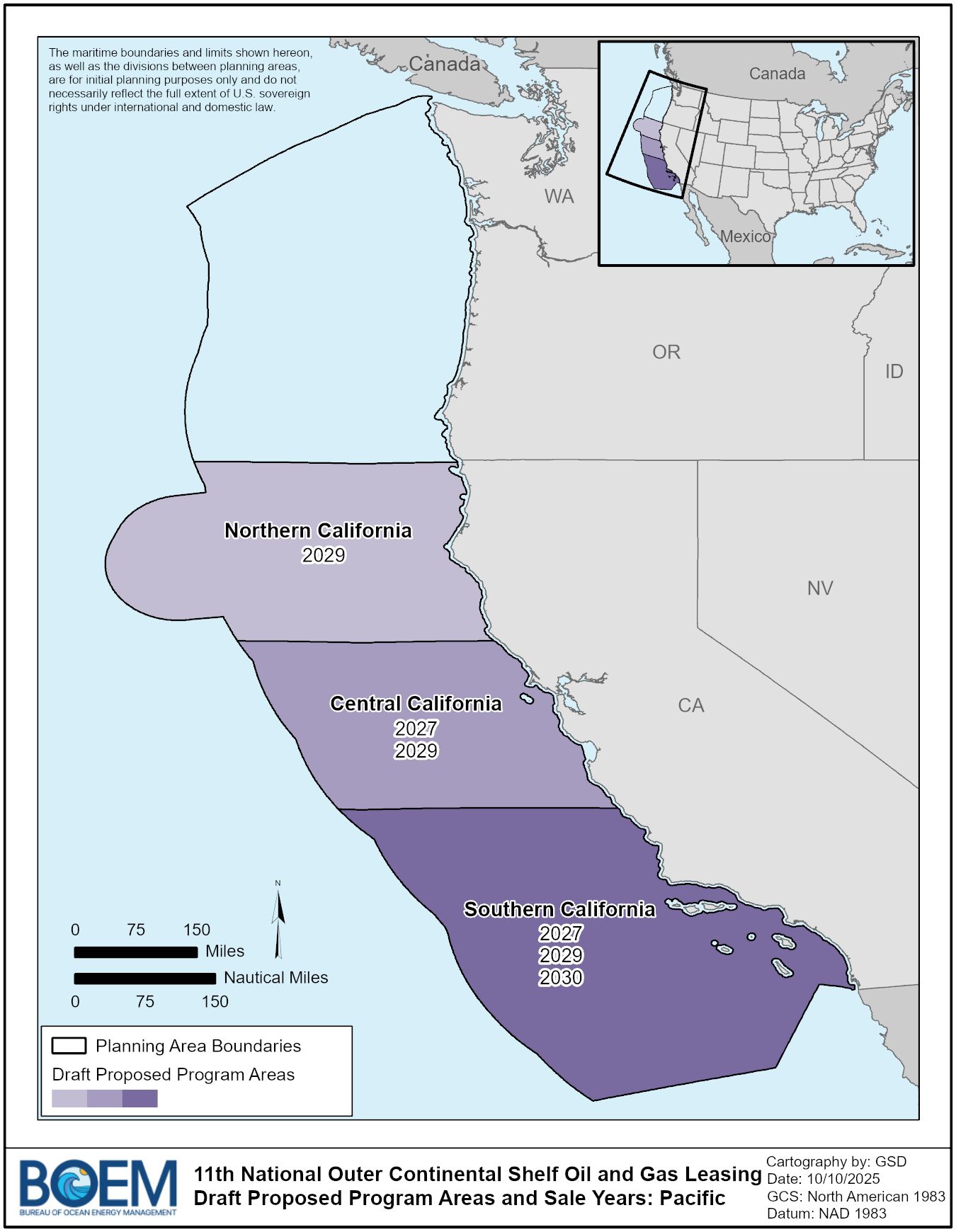
The Bureau of Ocean Energy Management’s (BOEM) 5-year plan for drilling in U.S. federal waters (from 3 - 200 miles offshore) was released Nov. 20, 2025. Their first proposal includes: Alaska with 21 lease sales (leasing begins 2026), California with 6 lease sales (leasing begins 2027), Gulf of Mexico with 7 lease sales (2027).
- BOEM Summary and Process Information
- Read the full proposal
- Comment period for the first phase of the proposal ended Jan. 23rd 2026
- Upon the release of the second proposal (date unknown) there will be a 90-day comment period
What is happening now?
- The public comment period for the first analysis and proposal are complete. Thanks to the strong actions of our community, more than 270,000 public comments were logged in response to the Trump administration's latest offshore oil and gas leasing plan. These comments are to be read, published and considered by the administration before the drafting and release of the second version of the proposal.
- On January 27, 2026 BOEM launched a new 30-day public comment period on potential oil and gas leasing off Central and Southern California that ends on February 26, 2026. This comment period is separate from the recently concluded comment period on the Draft Proposed Program. We are especially urging groups and businesses to submit comments to BOEM before the Feb 26 deadline.
This new comment period is an alarming development and shows that the Trump administration is very serious about expanding offshore drilling off the California coast.
The Administration has not ruled out all areas with National Marine Sanctuary status despite the fact that it carries a statutory ban on offshore oil and gas development under the National Marine Sanctuaries Act.
Ordinarily, this is done after the finalized plan has been released and public comment has been considered. Lease sales in Central and Southern California are scheduled for 2027, likely causing this acceleration in process, rushing through what should be a deliberate and transparent process.
How to Submit Comments:
By DEADLINE February 26, 8:59 PM PST
Preferred Method, online, submit comment according to location:
- CENTRAL CA COMMENT (BOEM-2025-0583): Regulations.gov
- SOUTHERN CA COMMENT (BOEM-2025-0582): Regulations.gov
Alternatively by Mail: In writing and mailed in an envelope labeled, “Comments on the Call for Information and Nominations for the (Southern or Central) California Planning Area Lease Sales”
Bureau of Ocean Energy Management, Pacific Region,
Office of Strategic Resources,
760 Paseo Camarillo (CM 102), Camarillo, California 93010
Talking Points (via Surfrider)
Individuals, groups and industry professionals should now submit comments discussing the impacts of offshore oil and gas development. Please submit your comment to BOEM stating that "The entire Central and Southern California Planning Areas must be protected from oil and gas leasing due to conflicts with human uses, ecological areas, and cultural resources."
We encourage to you to further highlight specific conflicts with the following:
- Potential use conflicts (recreation, boating, fishing, science, military, etc.
- Areas of special concern (ecological areas, MPAs, unique habitats, etc.)
- Socioeconomic information (economic benefits, quality of life, etc.)
- Environmental/ biological information (habitat for species, etc.)
- Archaeological resources (Tribal resources, etc.)
Save Our Shores is Reinvigorating the “Blue Wall”
In response to the 5YP, Save Our Shores is accelerating efforts to modernize and expand the California “Blue Wall” - a network of local zoning protections that restrict or require voter approval for onshore infrastructure tied to offshore drilling.
This strategy, first developed in the 1980s, empowered coastal communities to prevent the onshore facilities that offshore oil operations require. Strengthening and updating these ordinances is an effective tool available to block new drilling proposals.
Current actions include:
- Partnering with cities and counties to update existing ordinances and incorporate protections against supporting infrastructure for both offshore oil and seabed mining.
- Supporting statewide coordination through renewed local government efforts to oppose new federal offshore leasing.
- Expanding the Blue Wall to regions that did not previously face offshore development pressure but are newly included in federal plans.

Individual Action: What can you do today?
Your voice matters and representatives need to hear from you.
- See if your congressional representative has taken a stance on the issue.
- If they support offshore drilling - express your concern and opposition.
- If they oppose offshore drilling - express your appreciation for their strong stance and continued action to ensure protection of our environment and communities. Congressional bipartisan opposition remains our best chance at protecting our marine environment, shores and local communities
- Reach out to the Governor’s office expressing your opposition to the proposed work.
- Donate to support Save Our Shores’ advocacy efforts.
- Watch for updates and action items via SOS newsletter and social media.
- Spread the word, share information with your friends and family.
Local Offshore Oil Drilling Media Coverage:
ABC 7 News: Santa Cruz leaders speak out against federal plans for drilling off California coast
Santa Cruz Sentinel: Santa Cruz officials, ocean advocates unite to oppose offshore drilling
Lookout Santa Cruz: Santa Cruz County officials reviving a statewide coalition to block Trump's offshore oil drilling plans
CBS News Bay Area: Santa Cruz renews fight against offshore drilling plans
KSBW:
The Offshore Oil Drilling Issue:
What is at risk and Why do I care?
The federal proposal would open the California coast, including areas adjacent to existing marine sanctuaries, to new offshore oil and gas drilling and seabed mining for the first time in decades. Oil drilling can lead to significant risks, including:
- Habitat Destruction: Clearing and drilling into underwater areas to build infrastructure, destroying habitats.
- Disruption of Wildlife: Noise pollution and human/machine activity disrupt behaviors such as migration patterns, breeding and feeding. Oil spills poison and coat animals (birds cannot fly with oil on their feathers, seals cannot insulate themselves when coated with oil).
- Water Contamination: Oil spills contaminate water and spilled oil can seep into ground water systems used for drinking water.
- Impact on Local Communities: Expanding offshore drilling damages tourism, recreation, and fishing industries that generate enormous amounts of money for our local economy. Oil drilling releases greenhouse gases contaminating the air for local communities. The blight of drilling infrastructure leads to a drop in tourism. Toxic onshore processing facilities are disproportionately placed in communities of color.
- Climate Change: The process of pulling crude oil from the earth, transporting it, processing it and burning it for fuel - is the largest contributor to carbon emissions globally. The petrochemicals produced from oil and gas to make plastics fuel the immense waste stream we continue to produce globally.
Presidential executive orders and legislation have also authorized seabed mining for rare earths and precious minerals, with the Bureau of Ocean Energy Management (BOEM) regulating it in US federal waters.
How far out do we lose state jurisdiction?
There is a fixed boundary that extends 3 nautical miles off the entire length of the coast of California. Beyond that, Federal authorities (including BOEM) have decision making powers to roughly 200 nautical miles.
What is the OCS Local Government Coordination Program?
The OCS (Outer Continental Shelf) Local Government Coordination Program facilitates the local role in leasing proposals. Santa Cruz County Supervisor, Justin Cummings, has been working to engage California local governments in opposition to proposed offshore oil development and seabed mining.
We’ve been here before, We can do it again.
A History of Success:
Save Our Shores (SOS) was formed as a grassroots movement to prevent offshore oil drilling.
1985-1992 SOS’s campaign, advocating for the passage of local ordinances to effectively prevent offshore oil drilling, resulted in the adoption of 27 ordinances (Marin County added on in 2020), starting with the City of Santa Cruz’s Measure A, which directed the city to use its resources to fight offshore oil.
Some communities were sued by the Western Oil and Gas Association to overturn these ordinances, but local governments prevailed. Today, the 27 ordinances form a blue wall, defending the ocean from destructive drilling. The blue wall is ready to stand strong once again.